

Natural Veneer vs Reconstituted Veneer: Complete Comparison

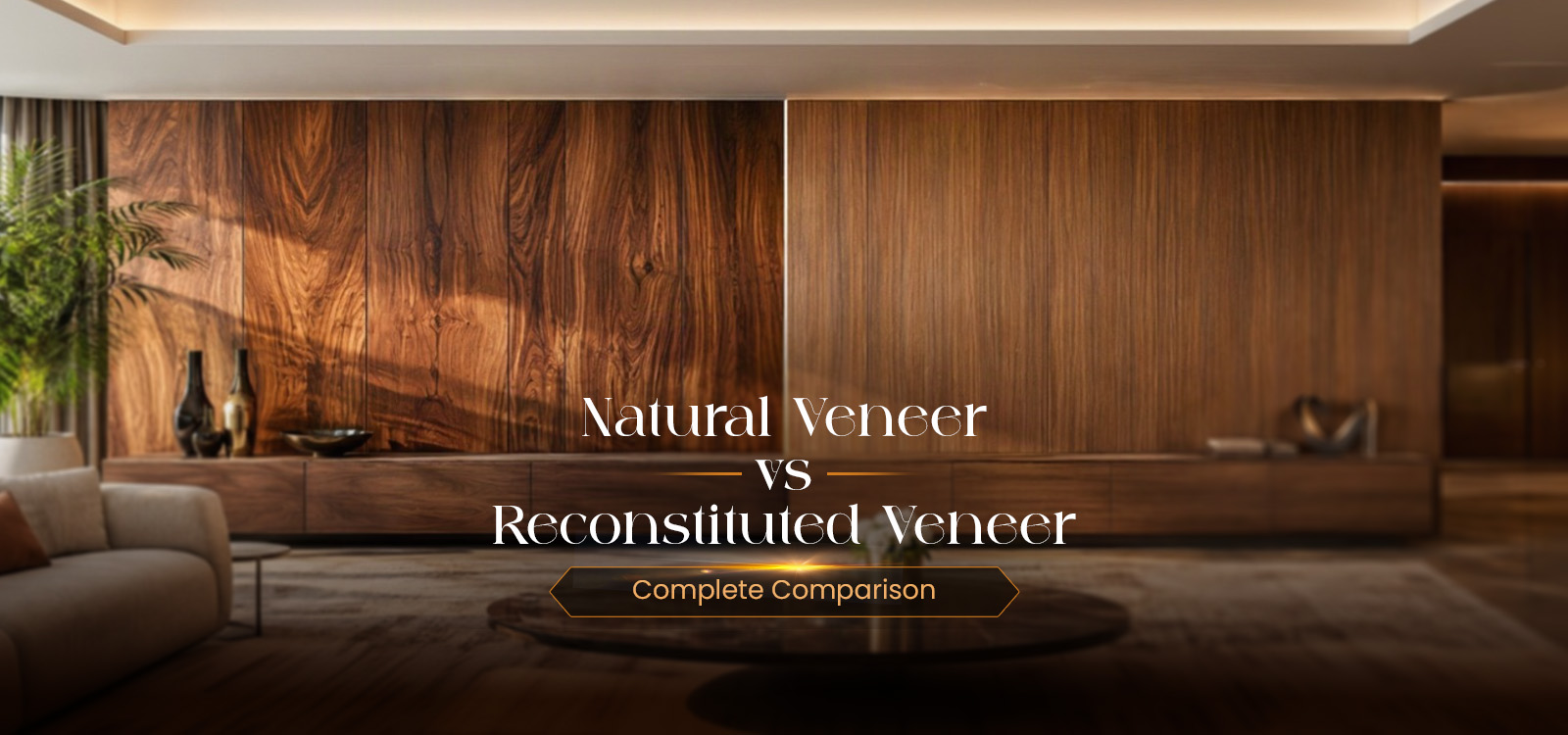
What to choose – natural or reconstituted veneer, will depend on the look, consistency and size of the project. Royale Touche natural veneer is composed of real timber retaining the characteristic grain, knots and colour variations of the original log. Reconstituted veneer, in contrast, is made of dyed wood fibres, and thus has a more uniform pattern. While engineered veneer can be used to achieve greater uniformity on large surfaces, Royale Touche natural veneer lends an organic character to the interiors.
Defining the Two Types of Veneers
Natural wood veneer is created from a real timber log, cut into thin sheets. Learn more about what a veneer sheet is and its different types. Each sheet shows a different part of the wood , depending on the way it is cut. There are other ways of cutting, and rotary slicing. Because of natural variations such as cathedral arches, knots and mineral streaks, no two natural veneer sheets are identical. Flitch matching is a process of joining adjacent sheets so that their natural grain flows attractively across a surface.
The production of reconstituted or engineered veneer varies. Fast-growing wood is turned into fibres which are dyed, stacked and compressed into blocks. The blocks are then cut into veneer sheets. This gives manufacturers control over the final look, eliminating many of the natural flaws, making Royale Touche engineered veneer a practical option when consistency is a factor.
Head-to-Head Comparison
| Feature | Natural Wood Veneer | Reconstituted (Engineered) Veneer |
| Grain Pattern | Organic, non-repeating, unique | Symmetrical, identical, repeating |
| Colour Consistency | Shade variation between sheets | Perfect batch consistency |
| Natural Flaws | Knots, mineral streaks present | Zero flaws or knots |
| Sustainability | Standard timber harvesting | Highly eco-friendly (fast-growing wood) |
| Installation Ease | High skill required for grain matching | Easier to install across large runs |
| Polish Requirement | Requires staining and clear PU lacquer | Prefers clear lacquer only (pre-dyed) |
The main distinction between reconstituted veneer and natural wood veneer is predictability. Natural veneer accepts variation . Engineered veneer requires controlled manufacturing for consistency . Natural veneer also requires more care in installation as sheets must be carefully matched for the desired grain flow.
When to Choose Natural Veneer
Natural veneer is the best choice when the specific character of real wood is important to the design. It works especially well for feature walls, dining tables, statement furniture and main entrance doors where every grain detail adds character.
The natural inconsistencies are not defects, but part of the allure of the material. If the homeowner wants a warm, real finish that has visible depth and character, Royale Touche natural veneer collection can produce a distinctive visual effect that is difficult to duplicate with engineered materials.
Natural veneer can show variation in shade and pattern from sheet to sheet. Hence the natural wood grain consistency is different for each type of timber, the way the timber is sliced and how the sheets are assembled.
When to Choose Reconstituted Veneer
Reconstituted veneer is best used in projects where uniformity of appearance is a priority. It is particularly good for corporate offices, hotel wall cladding, retail interiors and large runs of wardrobes or cabinetry.
The colour and grain pattern are consistent across the finished sheets because the wood fibres are dyed before they are compressed and sliced into sheets. This makes an eco-friendly reconstituted wood veneer a practical choice for covering large areas with minimal variation between panels. It is also important to think about when choosing the best veneer for wardrobe doors. One can keep the look consistent with multiple doors, making the room feel more coordinated and contemporary.
Conclusion
In the end, the decision between natural and engineered veneer comes down to design objectives. For true wood character, unique grain and natural variation, Royale Touche natural veneer is the more durable choice. Reconstituted veneer is superior when seeking to achieve consistent colour, a repeating grain pattern and a simpler installation over large areas. Knowing the strengths of each will help to choose the right veneer for furniture, walls and cabinetry. Whether the choice is for the unique character of natural timber or the predictable look of engineered material, Royale Touche natural veneer and its engineered counterparts offer choices for creating sophisticated, resilient interiors.
Frequently Asked Questions
1. What is reconstituted veneer and how is it made?
Reconstituted veneer is made by turning wood into fibres, dyeing them, then compressing into blocks and slicing into veneer sheets. Uniform colours and patterns are produced by the controlled process.
2. Is Royale Touche natural wood veneer better than engineered veneer?
There is no better. Royale Touche natural veneer is ideal for projects that appreciate genuine grain variation, while engineered veneer is best when a uniform colour and pattern is desired.
3. Why is there a colour difference between sheets of natural veneer?
Natural timber varies in age, density, minerals and growing conditions. These differences naturally cause variation in colour and grain between sheets of veneer.
4. How much cheaper is engineered reconstituted veneer compared to natural wood veneer?
Price varies by wood species, finish, thickness, design and project requirements. Compare the total installed cost not just the material cost. The natural veneer price per sq. ft. in India also varies greatly by species and grade.
5. Does engineered veneer require polishing after installation?
Reconstituted veneer is already stained so typically only requires a clear protective finish, not more stain. The final finish will vary according to the manufacturer’s recommendation.