

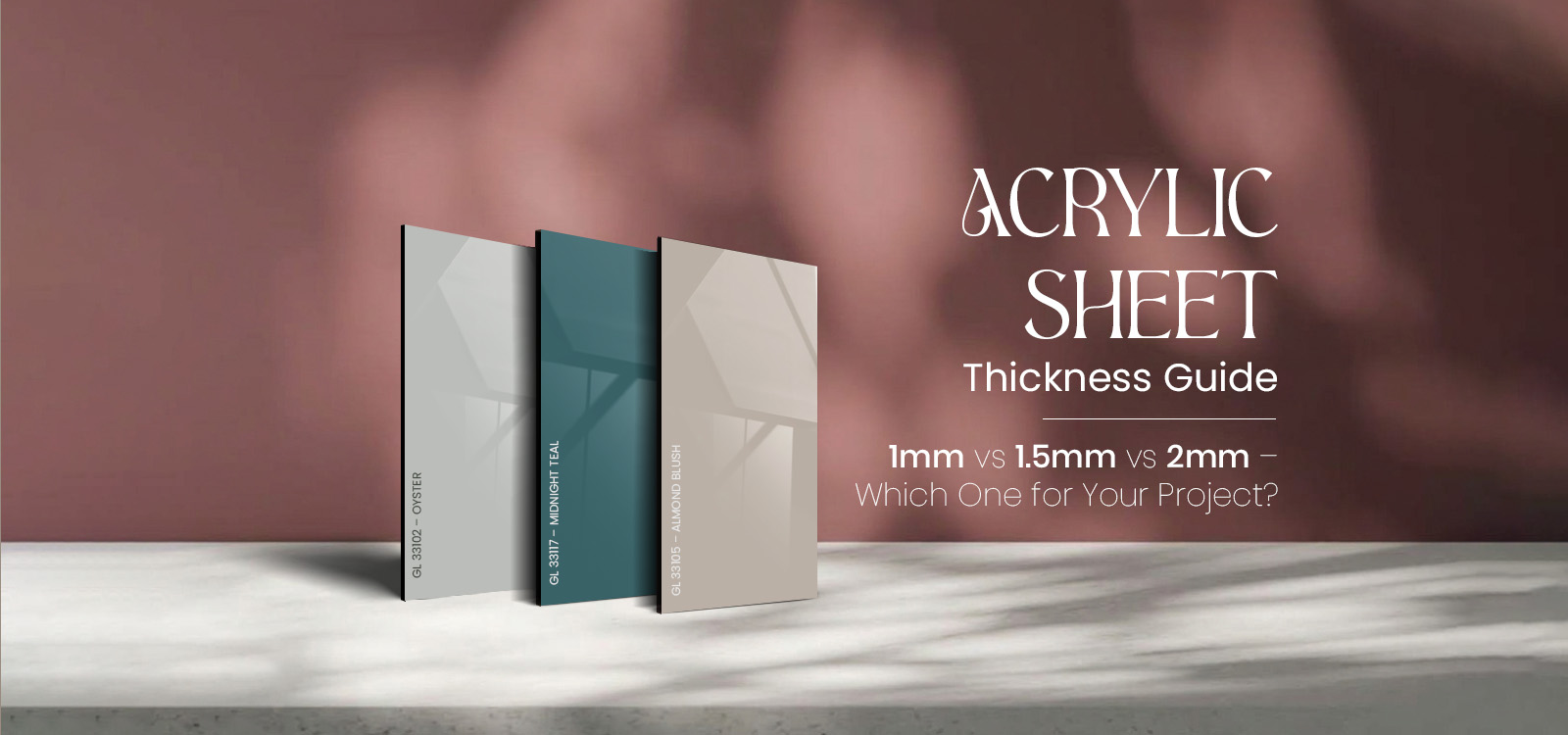
Acrylic Sheet Thickness Guide: 1mm vs 1.5mm vs 2mm Which One for Your Project?

An acrylic sheet thickness guide helps you select between 1mm, 1.5mm, 2mm and 3mm+ sheets based on the application. 1mm acrylic laminate sheets are used with substrate sheets, with a thickness of 1mm, which is ideal for kitchen shutters and wardrobe door slabs and valued at ₹60–₹110/sq ft. For premium sliding wardrobe use, 1.5mm and 2 mm acrylic can be ideal. For wall cladding, partitions and signage, sheets of 3mm+ thickness levels appear to be the best for self-supporting panels.
Why Acrylic Thickness Matters More Than You Think
The importance of thickness lies not simply in selecting the thickest acrylic sheet but rather in selecting the appropriate thickness based on the application. In any acrylic sheet thickness guide, the question of whether the sheet is bonded to a substrate (MDF/plywood) or is used in the capabilities of a self-supporting panel will impact the choice.
Using thicker sheets does result in added weight of furniture panel, making the use of hinges/sliding mechanisms difficult to operate, but edge finishing options can change as well, with the thinner acrylic laminate able to use PVC edge banding compared to thicker solid acrylic sheets, which can support laser-cut, polished, bevelled, chamfered, and rounded edge finishes. Cost also increases with thickness, making it important to choose the appropriate thickness based on the application rather than simply selecting the thickest option.
Thickness-by-Thickness Breakdown
| Thickness | Type | Substrate Needed? | Best Application |
| 1mm | Acrylic Laminate | Yes (MDF/Ply) | Kitchen shutters, wardrobe hinged doors |
| 1.5mm | Solid Acrylic | Yes (recommended) | Sliding wardrobe panels, premium cabinets |
| 2mm | Solid Acrylic | Optional | Display units, dresser tops, accent panels |
| 3mm+ | Solid Acrylic | No (self-supporting) | Wall panels, partitions, signage, retail |
A 1 mm acrylic laminate is most suitable when it is bonded to a strong MDF or plywood substrate, whereas thicker solid acrylic provides greater rigidity for larger or more demanding panels. When a project requires a thicker matt surface, a product such as MT 44114 Basalt Grey solid acrylic provides a useful reference for how solid acrylic differs from a thin decorative laminate in construction and application.
When choosing between 1mm vs 1.5mm acrylic sheet, the main differentiator to be considered is the thickness of the sheet as well as the overall support. A 1 mm acrylic laminate depends a great deal on the strength of its substrate, whereas thicker solid acrylic provides a good level of sturdiness.
The acrylic sheet thickness guide also helps compare the weight, rigidity and substrate dependency of different sheet constructions before selecting the appropriate option.
Application-Wise Thickness Recommendation
| Application | Recommended Thickness | Why |
| Kitchen upper cabinets | 1mm laminate | Lightweight and economical |
| Kitchen lower cabinets | 1mm–1.5mm | Resistant to high traffic |
| Sliding wardrobe doors | 1.5mm solid | Stiff enough to avoid bending |
| Walk-in closet panels | 1.5mm–2mm | Rich aesthetics and edge possible |
| Feature wall cladding | 3mm+ solid | Free-standing wall |
| Retail display/signage | 3mm–5mm | Structural and self-standing |
When it comes to modular kitchens, the acrylic sheet thickness for kitchen purposes will depend on whether it is installed as a laminate on MDF or plywood or whether it is used as a thick solid panel. The 1mm thickness is ideal for easy shuttering, while a thickness of 1mm to 1.5mm can be considered for lower cabinets that deal with the highest traffic.
For kitchens, the acrylic sheet thickness for kitchen applications should be considered according to the substrate, panel size and expected daily use.
For wardrobe doors, a thickness of 1.5mm solid acrylic is stiff enough for larger sliding doors. The appropriate acrylic thickness for wardrobe applications will thus vary depending on the size of the panel, type of support, as well as the opening mechanism.
In terms of wall applications, a thick acrylic sheet for wall panel uses enough rigidity for bigger sizes because the construction does not rely on plywood backing. Thus, sheets with 3mm of thickness or more will be helpful in applications requiring a self-supporting structure.
Edge Finishing Options by Thickness
| Thickness | Edge Options Available |
| 1mm (laminate) | PVC edge banding only |
| 1.5mm (solid) | Laser edge, polished edge, PVC band |
| 2mm+ (solid) | Laser edge, diamond-polished, bevelled |
| 3mm+ (solid) | All above components + chamfered and rounded edges |
Edge finishing is a crucial aspect of the acrylic sheet thickness guide, as thicker solid sheets yield greater finishing options. Laser-cut profiles, polished edges, bevelled edges, chamfered edges, and rounded edges give different visual effects depending on the project.
Common Mistakes When Choosing Acrylic Thickness
- Using 1mm laminate on large unsupported sliding panels, as they may flex and warp
- Using 3mm solid acrylic in cases in which 1mm laminate is sufficient
- Not considering hinge load capacity when selecting thicker sheets
- Not thinking about the edge finishing requirements when making a purchase
Another common mistake is ignoring the difference between acrylic laminate thicknesses and solid acrylic constructions that may look similar but behave differently. Royale Touche’s acrylic sheet thickness guide explains how application, substrate support, rigidity, edge finishing, and cost should be evaluated together before choosing a sheet thickness.
Conclusion
The appropriate thickness of acrylic depends on multiple factors, including the type of application, the size of the panel, the substrate material and the degree of rigidity required. The use of an acrylic sheet thickness guide can help to make distinctions between the various types of acrylic, such as the very light-weight 1 mm laminate, the more rigid solid acrylic of 1.5-2 mm, and the self-supporting acrylic sheets of 3 mm and more in thickness.
1 mm acrylic proves very efficient in the case of kitchens and standard hinged wardrobes, while larger sliding wardrobes can use 1.5-2 mm solid acrylic sheets. The wall panels, partitions, and signage may require acrylic sheets that are thicker than 3 mm. Choosing the thickness of acrylic sheets depending on actual requirements can help save money.
The acrylic sheet thickness guide therefore makes it easier to select a suitable thickness according to the application’s actual requirements rather than choosing a thicker sheet unnecessarily.
Frequently Asked Questions
1. Which acrylic thickness is best for modular kitchen cabinets?
For modular kitchen shutters, 1mm acrylic laminate is a good lightweight option as long as it is bonded properly to MDF or plywood. The lower cabinets may require 1mm to 1.5mm thickness at most, depending on their intended usage.
2. Is 1mm acrylic laminate the same as 1.5mm solid acrylic?
1mm acrylic laminate differs from 1.5mm solid acrylic. The former is supposed to stick to the substrate, while the latter is more rigid and can be used in applications requiring a thicker panel.
3. Do I need plywood behind a 3mm acrylic sheet for wall panels?
The outline defines 3mm solid acrylic as self-supporting, ng so plywood would not have to be used. Still, structural requirements and installation conditions should be considered when choosing the construction. The 3mm solid acrylic sheet uses include wall panels, partitions, signage and other applications requiring self-supporting construction.
4. Does thicker acrylic sheet give better scratch resistance?
Thickness affects rigidity and structural properties. Scratch resistance is determined mainly by the acrylic material type, surface finishing and protective properties.
5. How does acrylic thickness affect the overall furniture cost?
Thicker constructions should utilise more materials; therefore, thicker acrylic will be more expensive per square meter. Choosing appropriate thickness is better than the traditional preference for the thickest option.