

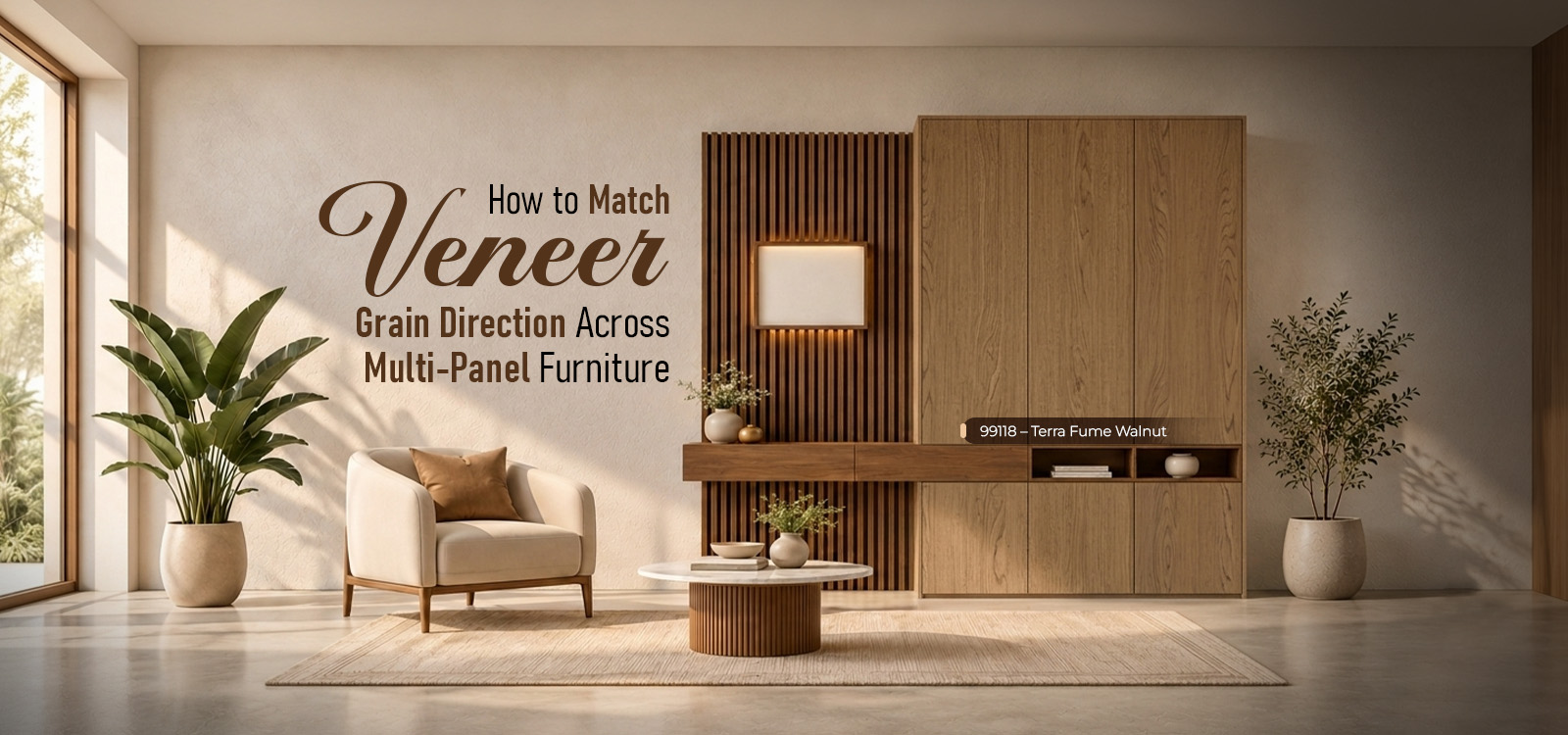
How to Match Veneer Grain Direction Across Multi-Panel Furniture

Matching the direction of the grain in veneer across several panels is the difference between a beginner installation and a professional look. Veneer grain direction matching produces a coherent and high-end design on the entire item. The bookmatching technique produces mirror-like symmetry,while slip-matching guarantees a smooth flow of grain, and random matching results in an appearance of rusticity. It is only necessary to order sheets that are from the same piece and keep them numbered until the process of cutting them starts.
Why Grain Direction Matters in Veneer Projects
Natural veneer sheets can vary in grain pattern and colour, so planning the sequence before cutting is essential. Designers working across wardrobes, wall panels, or long furniture runs can explore Royale Touche Luxe Veneers while considering sheet-to-sheet consistency, grain character, and the visual rhythm required across the complete installation
- Mismatched grain: the furniture appears to be made from patches
- Uniform grain flow: elegant and flawless appearance
- Variations in colour between the sheets are not a problem; what matters is how they flow.
Ensuring uniformity is highly important for big surfaces because any inconsistency is likely to be more visible.
The 3 Main Veneer Matching Techniques
| Technique | How it Works | Visual Effect | Great for |
| Bookmatching | Select sheets alternate flipped like pages in a book | Mirrored symmetry (butterfly effect) | Feature walls, dining table tops |
| Slip Matching | All sheets are oriented the same way | Repeated grain flow | Wardrobe runs, long wall panels |
| Random Matching | Sheets are placed with no regard to grain direction | Rustic/organic look | Casual industrial interiors |
Bookmatched veneer panels work especially well when the design needs a symmetrical and dramatic centre, whereas slip matching is better for continuous grain flow across longer furniture runs. A bookmatched veneer headboard design is a useful example of how mirrored veneer sheets can turn grain direction into a deliberate focal feature rather than simply a surface finish.
While doing the comparison of slip match vs book match veneer, it is important to choose the right one depending on your design idea. Book matching is ideal for situations when symmetry is important, while slip matching has the edge when it comes to continuous furniture runs.
Step-by-Step Guide to Achieving Perfect Grain Match
A successful veneer grain matching technique should be started well in advance, even before cutting or installation. Sheets should be kept in proper order before they are cut or installed so that the grain direction is not interrupted.
- Obtain all veneer sheets from the SAME flitch (the same section of a log)
- Number each sheet in sequence before unpacking
- Lay out all sheets on the floor in proper order before cutting
- Decide on what technique to use (book/slip/random) depending on the design of the furniture
- Mark grain direction arrows on the backside of each sheet
- Start cutting and installing in a consecutive manner. Use an identical stain or polish across all panels
These steps help to make sure the veneer grain directions are matched properly and to keep the same flitch sequence through the project. The process of numbering the panels is especially helpful when several large sheets of veneer are being processed at once.
The right technique for veneer grain matching also helps give visual continuity between multiple furniture panels. Careful veneer grain direction matching before cutting helps ensure that the intended grain flow is maintained.
Application-Wise Matching Recommendations
| Furniture Type | Best Match | Reason |
| 4-door wardrobe | Slip (all 4 door panels) | Ensures a coherent grain matching |
| Feature wall (entire wall) | Book match (middle 2 panels) + slip (side ones) | Interesting in the centre, calm on the sides |
| Dining table top | Book match (2 sheets) | Finally, symmetrical grain = premium appearance |
| Kitchen cabinets | Slip match (per row) | Consistency of appearance |
| Office panelling | Slip match (long length) | Professional appearance |
When it comes to grain continuity on wardrobe doors, a slipping method can ensure a uniform visual effect on all 4 doors at once. Both the feature wall and dining table will benefit from book matching if a symmetrical centre effect is desirable.
Yet, knowing how to align veneer sheets is also crucial for achieving a good grain flow across adjacent panels. It is necessary to devise a strategy for the layout before cutting so that the grain directions correspond to the furniture being constructed.
Common Grain Matching Mistakes
Even the most well-thought-out veneer grain matching technique can be ruined by mistakes during installation.
- Ordering sheets from various flitches (various logs == various grain)
- Absence of sheet numbering results in a lack of sequence
- Mixing grains in nearby doors
- Applying various coats of polish on several panels (different colours)
The above-mentioned problems can be reduced greatly by strictly following the original veneer flitch matching guide and keeping the sheet order. The main goal here is to achieve uniform grain direction and visual harmony between the panels.
Maintaining veneer grain direction matching throughout the installation also helps preserve the intended grain flow and visual continuity.
Conclusion
To successfully achieve veneer grain direction matching on several pieces of furniture, one needs to plan things before cutting and choose the right techniques for matching and keeping the order of flitches. Book matching ensures the symmetry of the furniture set, while the slip matching guarantees the uniform grain movement. Numbering the panels, keeping them in order, and using the proper finishing materials will allow using veneers to create a natural appearance.
Frequently Asked Questions
1. What is book matching in the industry of wooden veneers and when should it be used?
Book matching refers to the process of ordering wooden veneer pieces in such a way that they are flipped in the same manner as the pages of the book.
2. How do I ensure that all the grains of the wardrobe’s 4 doors will follow the same direction?
To have the grain on the wardrobe’s 4 doors follow the same path, the veneer sheets should be taken from a flitch and positioned in the original order.
3. What is a flitch and what role does it play?
Flitch is a veneer sheet produced from the same part of the tree trunk. The importance of the flitch is that once we figure out the layout of veneer sheets, we obtain the identical veneer pattern in all elements.
4. Is it possible to deliberately mix up the grain direction of various elements for a more rustic appearance?
Yes, in the process known as random matching the different grain patterns and directions are intentionally mixed resulting in a messy, natural look. This approach is great for the rustic and industrial styles since it doesn’t need perfect continuity.
5. How to order veneer sheets from one flitch?
To get veneer sheets from a single flitch, contact the veneer supplier and indicate how many panels are needed for one order in such a way that the sheets will be received in their original order.