

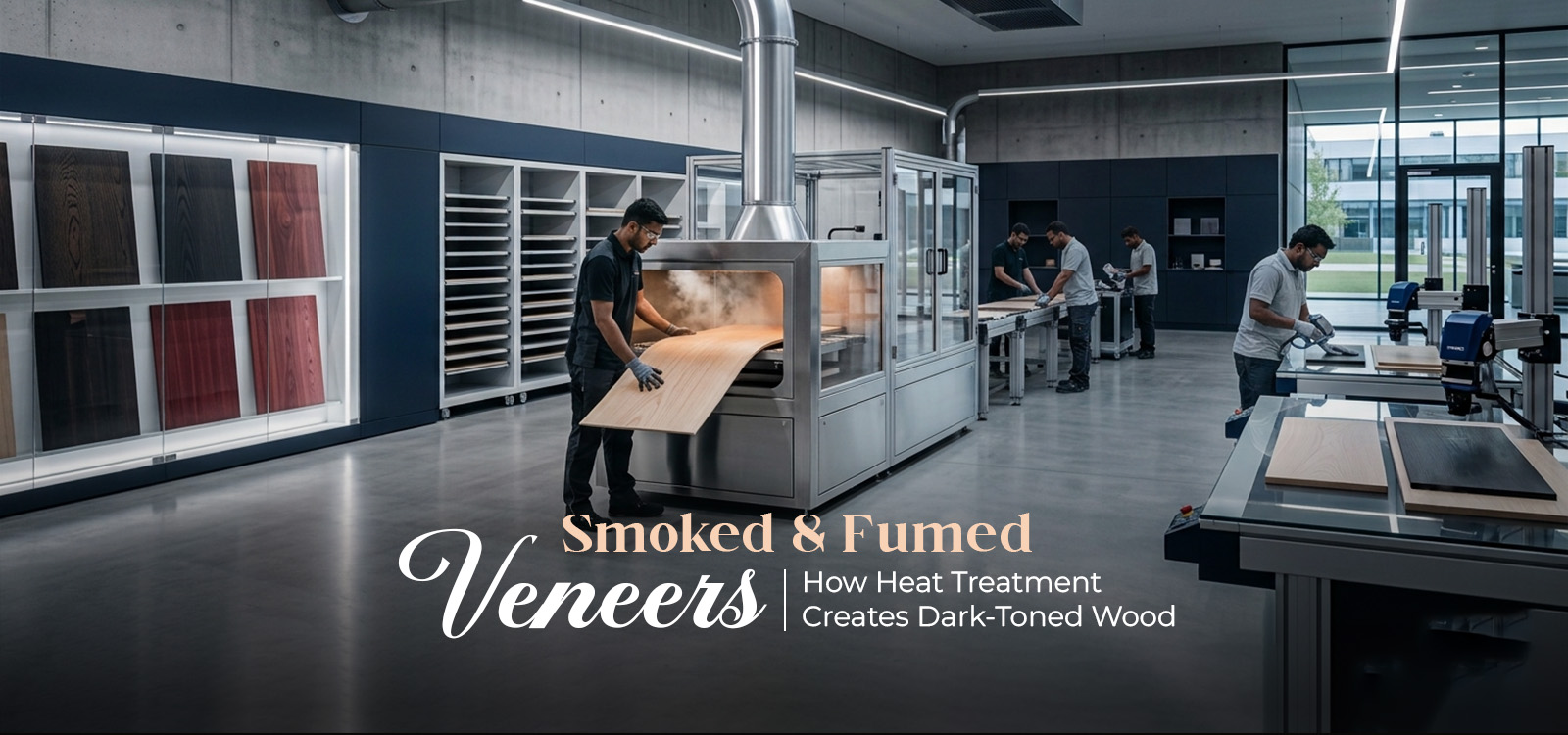
Smoked & Fumed Veneers: How Heat Treatment Creates Unique Dark-Toned Wood

A smoked veneer sheet is produced by the process of exposing wood veneer to ammonia vapour in enclosed conditions. The effect of ammonia in the presence of tannins results in darker wood from within, and not just on the surface. This chemical-free darkening process results in dark tones of grey-brown, chocolate, and dark charcoal while leaving the natural pattern visible. The great thing about this process is that the colour is created through the wood rather than on the surface like with traditional painting or staining. This is also why heat-treated wood veneer is increasingly considered for interiors that require distinctive dark wood tones.
What Is Smoked/Fumed Veneer?
A smoked veneer sheet is natural wood veneer that has been treated by fuming so that the colour changes. The treatment is mostly seen in oak and other types that have enough amount of tannins to allow the reaction with ammonia.
- The ammonia fuming process is performed in a sealed box, usually with controlled exposure for a period of 24-72 hours.
- The reaction of ammonia and wood tannins creates the colour change that lasts forever.
- Woods like oak, eucalyptus, and chestnut are the ones that get excellent results with this process.
- The colours can be anything from warm brown, grey-brown, to darker shades of charcoal.
Thus, the process emphasises the natural pattern of wood instead of covering it.
This makes smoked and fumed veneers useful for designers who want darker wood tones while keeping the grain visually active. A relevant example is Fumed Claro Mocha veneer, where the fuming process is used to develop deep mocha tonal transitions while preserving the natural movement of the walnut grain.
Smoked Veneer vs Stained Veneer vs Dyed Reconstituted
| Feature | Smoked/Fumed Veneer | Stained Veneer | Dyed Reconstituted |
| Colour penetration | Through-body (permanent) | Surface only (2–3mm) | Through-body |
| Fade resistance | Excellent (won’t fade) | Moderate (fades in sun) | Good |
| Natural grain visible | Enhanced | Partially hidden | Artificial grain |
| Chemical-free | (ammonia evaporates) | Uses chemical stains | Uses dyes |
| Repair/sand | Can be sanded — colour stays | Sanding removes colour | Sanding OK |
| Price (₹/sq ft) | ₹150–₹300 | ₹100–₹200 | ₹60–₹120 |
| Uniqueness | Every sheet unique | Uniform tint | Perfectly uniform |
In the case of smoked veneer vs stained veneer, the main difference is how the colour is achieved: fuming changes the wood through a tannin reaction, whereas staining mainly modifies the surface tone. When the comparison also includes dyed engineered options, understanding natural veneer vs reconstituted veneer helps clarify why grain variation, colour consistency, and manufacturing method can differ significantly between the available materials
This is why smoked veneer sheets can appear to have a more naturally integrated dark hue with preserved characteristics of an initial wood structure. The tannin reaction also allows the natural grain to remain visually prominent.
Best Wood Species for Smoking/Fuming
| Species | Tannin Level | Resulting Colour | Best Application |
| European Oak | Very High | Deep grey-brown | Feature walls, dining tables |
| Eucalyptus | High | Dark charcoal-grey | TV unit panels, wardrobes |
| Chestnut | High | Warm dark brown | Traditional furniture |
| Ash | Low | Light grey (subtle change) | Modern minimal accents |
| Walnut | Moderate | Deeper chocolate | Luxury cabins, headboards |
Oak is best suited for fuming due to its higher level of tannins. The fumed oak veneer in Indiana is especially good for statement furniture, wall panelling, and luxurious interiors in houses.
Eucalyptus gives interesting results too, as the smoked eucalyptus veneer suits wardrobes, TV units, and other big surfaces creating dark modern aesthetics.
The natural grain can also benefit from cathedral grain enhancement, particularly when the veneer species has a strong and distinctive grain structure.
5 Design Ideas with Smoked Veneer
A smoked veneer sheet can be applied in various ways to add depth and richness of wood tone to the interior.
- Full-wall smoked oak TV unit backdrop.
Use deep grey oak to build a focal point on the TV wall. - Fumed eucalyptus wardrobe doors with brass fittings
Match dark eucalyptus with warm metal parts. - Dark smoked dining table with natural oak chairs
The contrast between some dark and some light wood gives the room a balanced appearance. - Bed headboard made of smoked walnut wood with LED backlight illumination
Dark wood can create a more sophisticated and warm atmosphere when combined with indirect lighting. - Boardroom finishing in fumed oak
Fumed oak provides a boardroom with an elegant and heavy look. For the designers who prefer dark veneer without chemical stain, the smoked and fumed finishing of materials offers a solution by employing the natural tannin content of wood species as a coloring medium.
Heat-treated wood veneer can similarly be considered when the design requires a distinctive treated-wood appearance.
Care & Maintenance of Smoked Veneers
A smoked veneer sheet usually needs treatment almost identical to natural veneers.
- Dust regularly using a microfiber cloth.
- Clean it with a slightly moist cloth when needed.
- Apply a proper PU re-coat at the time of finish maintenance.
- The colour is absorbed by the wood, not just lies on its surface.
- Prevent prolonged exposure to sunlight since natural wood can change colour due to UV overdose as well.
Since the process of colour imparting is done internally, the material does not become like a regular stained surface that can be easily removed by sanding.
Conclusion
A smoked veneer sheet is one of the options to add a new, deep color, while keeping the character of wood. This happens due to ammonia treatment of wood,which interacts with tannins, producing brown-grey and black shades which are often used with oak, eucalyptus, and chestnut wood. The use of smoked veneers is extremely effective for building feature walls, cabinets, tables, and even office walls.
Frequently Asked Questions
1. What is the difference between smoked veneer and stained veneer?
Resin is made by the influence of ammonia on the tannins available in wood trees, while stained veneer has a coating on its surface applied with the This underscores the relevance of understanding the differentiation of smoked veneer versus stained veneer when opting for a type of veneer based on visual aspects, grain visibility, and necessity for a possible refinishing analysis.
2. Does smoked veneer fade over time?
Smoked veneer provides high stability because the wood is changed in colour rather than only having a colour layer applied to the surface. However, the veneer still must be used in a place without prolonged sunshine; as with other wood products, it might wear due to the sun.
3. Which wood species can be fumed/smoked?
High-tannin kinds of wood are the best choice for fuming. Commonly, oak, eucalyptus, and chestnut can be used, while other kinds of wood with lower tannin concentrations get less detectable colour change. The outcome highly depends on the wood type and its features.
4. Is smoked veneer more expensive than regular natural veneer?
The production process for smoked and fumed veneers is more involved compared to a simple veneer, which differentiates the price in general. Further, the cost can be influenced by such factors as the kind of wood, veneer thickness, quality of surface finish used, and the way of application.
5. Can smoked veneer be sanded and refinished?
Yes. Sanding is often possible with smoked veneer when applied cautiously. Even though the smoke changes the colour of the wood rather than remaining only on the surface, the veneer should be looked after properly so that the surface layer is not damaged.