


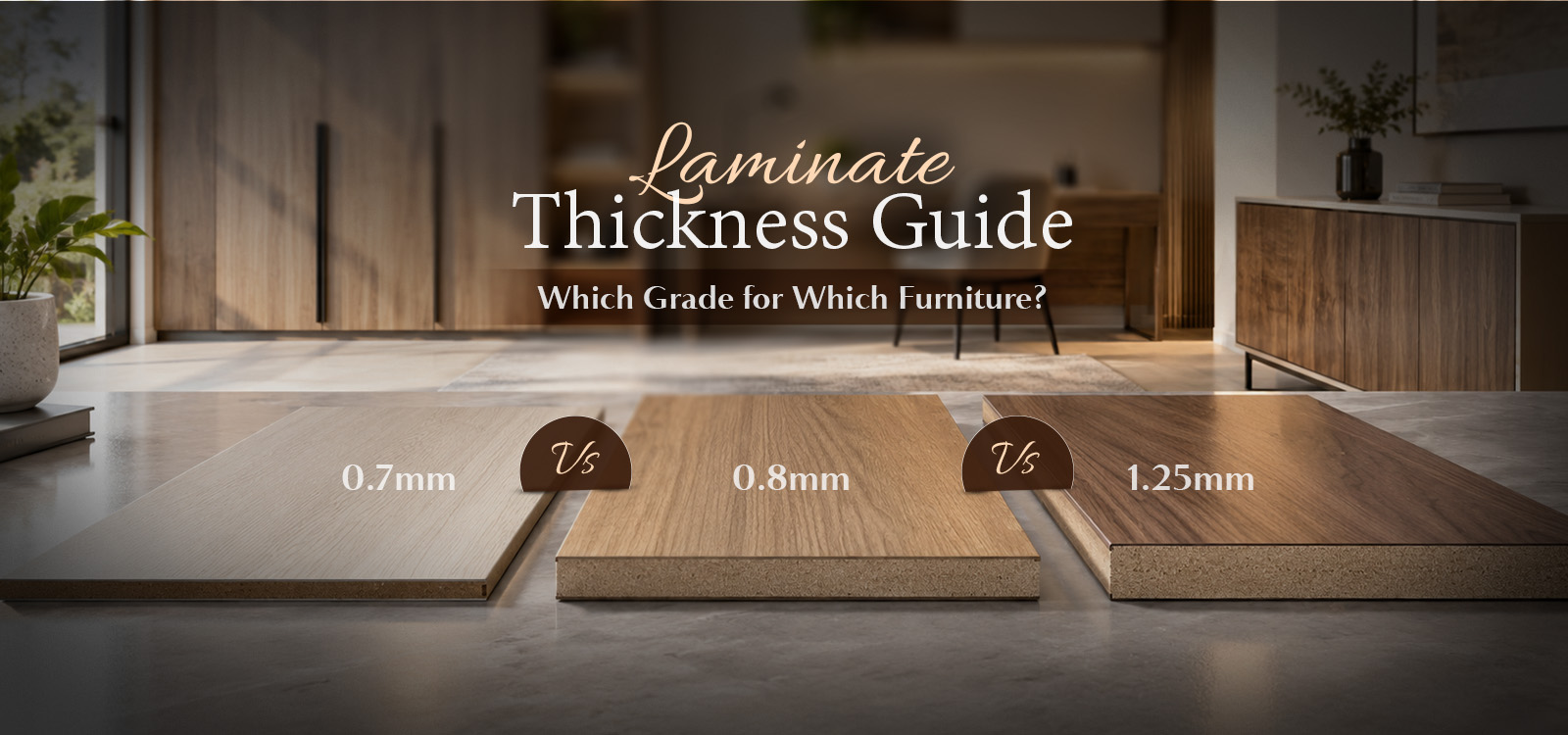
Laminate Thickness: 0.7mm vs 0.8mm vs 1.25mm Which Grade for What Furniture?

A laminate thickness guide will help you to choose the right thickness for furniture, taking into account durability, flexibility and purpose of use. A thickness of 0.7mm is suitable for interior shelving or less-used furniture; 0.8mm can be used for wardrobes and study tables, while 1.25mm is applicable to selected high-use surfaces and commercial furniture.
Why Laminate Thickness Matters
Laminate thickness impacts surface performance; however, it is essential to consider the quality of the particular product, as well as the substrate and installation.
- Durability: Thicker laminates can better withstand impact and scratches.
- Kraft paper layers: Quality of construction and resin content are important for performance.
- Flexibility: Post-forming grade laminates are designed for suitable curves and specified bending radii.
- Cost efficiency: Choosing the required laminate grade helps achieve durability within a reasonable budget.
Thus, a well-constructed laminate thickness guide will help you avoid selecting the wrong material and paying additional costs.
Laminate Thickness Guide Breakdown
| Thickness | Industry Name | Durability | Best Use |
| 0.6mm | Backer / Liner grade | Low | Backing, lining of interior carcass |
| 0.7mm | Economy / Commercial | Moderate | Inner shelves, loft shutters |
| 0.8mm | General Purpose (GP) | Good | Wardrobes, study tables, bedside tables |
| 1.0mm | Premium Decorative | High | Kitchen shutters, TV units |
| 1.25mm | Thick / Compact Decorative | Extremely High | Countertops, commercial furniture |
| 1.5mm+ | Post-forming grade | High | Bent edges, round counters |
The actual construction and performance will differ from manufacturer to manufacturer, so thickness should always be checked against the specific product range. For heavier-use applications, designers can review Royale Touche Exclusive Savahh 1.25 mm laminates as an example of a thicker laminate category intended for premium furniture and demanding interior applications.
Understanding Different Laminate Thicknesses
The most common 0.7mm laminate uses are in the fabrication of hidden shelving, interior carcasses and loft shutters. The common 0.8mm general-purpose grade can be used to produce everyday furniture items. As for the 0.8mm vs 1mm laminate difference, the distinction depends on the product specifications and application.
It is necessary to confirm the specifications for the 1.25mm compact laminate grade with the manufacturer, as compact grade is different from other products in this category. There is a difference between thick decorative laminates and flexible post-forming laminates because their purposes vary.
Furniture-Wise Thickness Recommendation
| Furniture / Application | Recommended Thickness |
| Hinged wardrobe doors | 0.8mm |
| Sliding wardrobe doors | 0.8mm–1.0mm |
| Kitchen upper cabinets | 0.8mm–1.0mm |
| Kitchen lower cabinets | 1.0mm–1.25mm |
| Kitchen countertop | 1.25mm, if suitable for the application |
| Desk table | 0.8mm |
| Bed headboard | 0.8mm |
| TV unit | 0.8mm–1.0mm |
| Commercial workstation | 1.0mm–1.25mm |
| Inner shelves | 0.7mm |
| Loft shutters | 0.7mm |
| Retail counter | 1.25mm |
If you are wondering which laminate thickness for wardrobe doors is ideal, 0.8mm is a good place to start for conventional hinged doors. Sliding doors can use 0.8mm–1.0mm, depending on the type of construction.
The thickness of the laminate sheet for kitchen furniture varies depending on its location and use. Upper cabinets can use 0.8mm–1.0mm, but lower cabinets may need thicker grades. You should choose the laminate according to the intended application.
How Thickness Affects Performance
| Performance Factor | 0.7mm | 0.8mm | 1.0mm | 1.25mm |
| Impact resistance | Low | Moderate | Good | Excellent |
| Heat resistance | Low | Moderate | Good | Excellent |
| Edge chipping | High | Moderate | Low | Very Low |
| Post-forming | Generally not suitable | Generally not suitable | Generally not suitable | Depends on grade |
Actual performance depends on the product properties, substrate, and installation method. Not all standard-thickness laminates are suitable for bending. Post-forming requires special flexible grades and the appropriate bending radius.
Common Thickness Selection Mistakes
- 0.7mm used for kitchen shutters: Frequently used surfaces may get damaged sooner due to an unsuitable thickness.
- 1.25mm used for hidden shelves: This increases the cost without any notable advantage.
- 0.8mm selected for countertops: General-purpose laminate may not be appropriate for heavy use.
- Using different grades interchangeably: Decorative laminate and post-forming laminate serve different purposes.
To choose the right laminate thickness, consider how the furniture will be used, the substrate, edge treatment, and the performance required from the surface. Royale Touche’s laminate thickness guidance notes common options such as 0.8 mm, 1.0 mm, and 1.25 mm and explains why thicker laminates may be preferred for higher-traffic or heavier-use applications.
Cost Impact of Thickness Choice
| Kitchen Size | Total for 0.8mm GP | Total for 1.0mm Premium | Difference |
| Small (8 shutters) | ₹4,000–₹9,600 | ₹6,400–₹14,400 | ₹2,400–₹4,800 |
| Medium (14 shutters) | ₹7,000–₹16,800 | ₹11,200–₹25,200 | ₹4,200–₹8,400 |
| Large (20 shutters) | ₹10,000–₹24,000 | ₹16,000–₹36,000 | ₹6,000–₹12,000 |
These are approximate figures; prices may vary depending on the manufacturer, style, waste, labour,r and location. When comparing laminate grade and thickness in India, ask for quotations for similar products and finishes.
Conclusion
A practical laminate thickness guide begins with the intended use of the furniture. Use 0.7mm laminate for suitable low-use surfaces, 0.8mm for everyday furniture and 1.0mm or 1.25mm for more demanding applications. Always refer to the manufacturer’s specifications when selecting a grade.
Frequently Asked Questions
1. What Laminate Thickness Is Used for Home Furniture in India?
A common thickness used for cabinets, beds, and desks is 0.8mm.
2. Is It Better to Choose 0.8mm or 1mm Laminate for Kitchens?
0.8mm vs 1mm laminate difference depends on the design of the product and how often the surface is used, product specifications.
3. Is Thicker Laminate Better for Furniture?
Choose the laminate thickness according to the surface where it will be used. Using thicker laminate on a low-use surface may be cost-inefficient.
4. What Is Better: 0.7mm or 0.8mm Laminate?
For low-use surfaces, 0.7mm laminate is often used, but everyday furniture is more likely to be made from 0.8mm laminate.
5. Which Thickness of Laminate Is Suitable for Office Furniture?
A 1.0mm or 1.25mm laminate may suit office furniture, depending on the product specifications and intended use.
6. Can You Use 0.8mm Laminate for Kitchen Work Surfaces?
It is not safe to assume that standard 0.8mm laminate is suitable for kitchen surfaces. Use laminate specifically rated for countertop applications.