

Digital Print Laminates Vs Solid Color Laminates: Key Differences Explained

Interior designing of a home, office or commercial space is not only about the layout but also about the choice of laminate finishes chosen that enhances the visual appeal as well as the functionality of the space. From the variety of laminate finishes available, printed laminates and solid color laminates are commonly chosen ones. While both are laminates types, they are meant to serve certain design requirements, purpose and perform differently. Let us see each of these finish and when to choose which type of finish
Understanding Printed and Digital Laminates
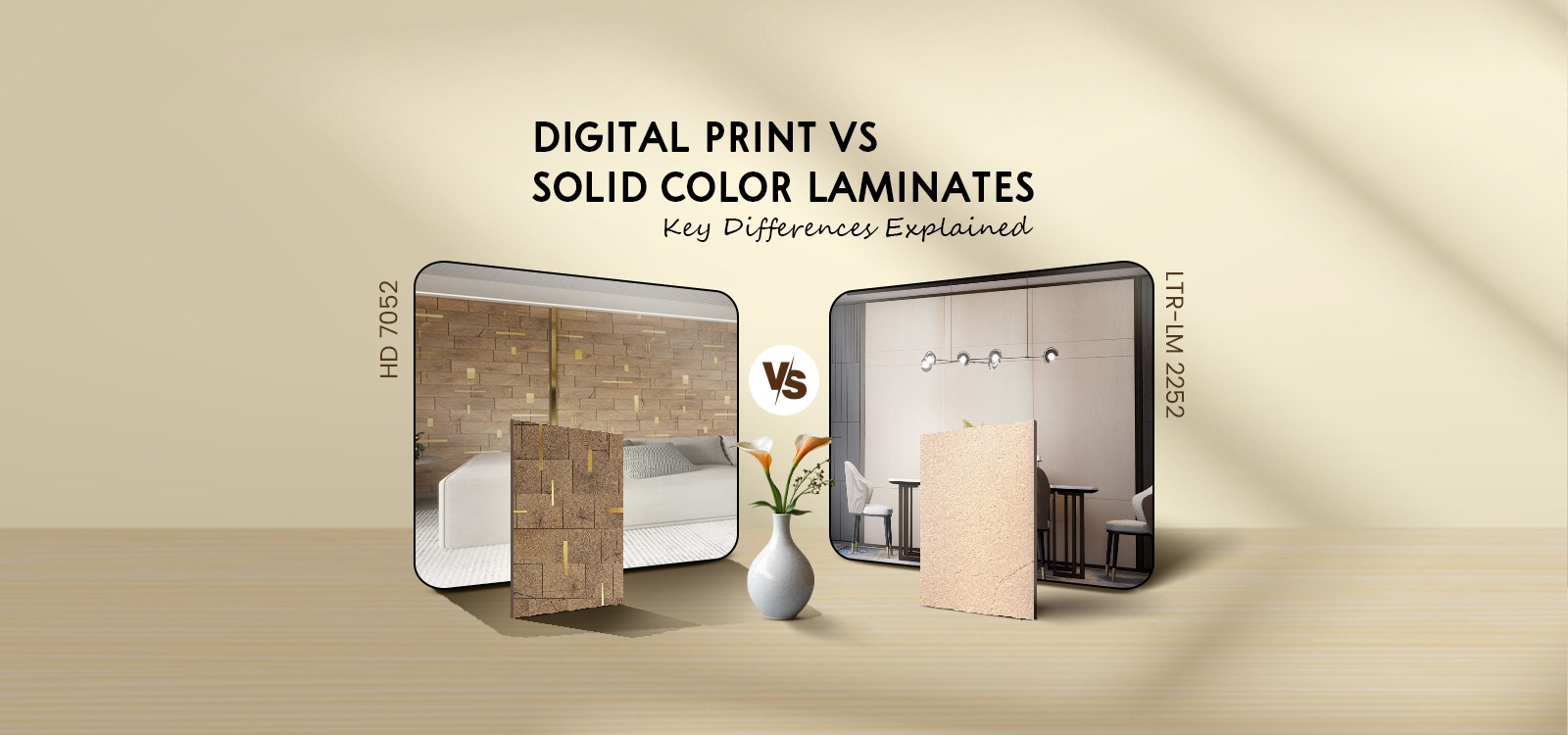
Printed laminates are manufactured by printing, transferring designs, images or certain patterns on decorative surface sheets created by transferring designs, patterns, or images onto decorative paper with the help of printing techniques. These can be prints of wood grains, stone textures, abstract patterns, or themed visuals. The use of digital laminates helps one achieve sharper detailing, better colour accuracy, and more design flexibility.
Digital printing allows intricate visuals that closely resemble natural materials without their maintenance challenges. As a result, digital laminates are often chosen for statement surfaces such as wardrobe shutters, accent walls, headboards, or reception desks. The emphasis here is on visual impact and surface storytelling. Because these laminates carry detailed patterns, they are particularly useful in spaces where design variety is required without changing materials frequently.
What Are Solid Color Laminates?
Solid color laminates are exactly what the name suggests—laminates available in uniform, single-tone colours with minimal or no patterns. These laminates focus on consistency, clean lines, and subtle elegance. They are commonly used in kitchens, office furniture, wardrobes, and commercial interiors where simplicity and uniformity are preferred.
Solid finishes help create calm visual zones and allow other design elements—such as lighting, furniture shapes, or textures—to stand out. In many modern interiors, solid color laminates act as a neutral base that supports long-term usability without appearing dated. Their simplicity also makes them easier to match across panels, especially in large-scale projects like offices or hospitality interiors.
Visual Impact and Design Flexibility
From a design perspective, printed laminates and digital laminates offer higher visual variety. They allow designers to experiment with finishes that replicate wood, marble, fabric, or even artistic graphics. This flexibility is valuable when a space needs character without relying on multiple materials. Both options can coexist in the same space—printed laminates for focal areas and solid colours for supporting surfaces.
Maintenance and Everyday Practicality
Maintenance is a key differentiator when it comes to laminate comparison for interiors. Solid color laminates generally hide dust, minor scratches, and wear more effectively, especially in lighter or matte finishes. Their uniform appearance makes cleaning and upkeep simpler in high-use areas.
Printed laminates, particularly those with detailed or high-contrast patterns, may show wear differently depending on the design. For spaces such as kitchens, children’s rooms, or offices, solid color laminates often offer better long-term practicality. Printed laminates are better suited for vertical or decorative applications where heavy abrasion is less frequent.
Application Across Interior Spaces
Both digital as well as solid color laminates have their own use. Printed laminates are commonly used on wardrobe shutters, wall panels, and feature furniture where visual appeal is preferred. They are also used in retail and hospitality interiors for branding and thematic consistency.
Solid color laminates are commonly preferred in modular kitchens, storage units, workstations, and cabinets.
Cost and Long-Term Value
When comparing the price of solid color and digital laminates, solid color laminates are relatively economical. Printed laminates cost relatively higher given the design complexity and finish quality.
The choice between the two laminates shouldn’t be made only on the basis of price, but also the visual value they provide to the interior décor theme. Providing the right balance between cost, design intent, and lifespan is essential when selecting the choice of laminate.
Every single printed laminate has its own purpose in interior design and choosing the right one depends on the space where it will be utilized, the lighting, and how much time can one invest in cleaning and maintenance. Explore the variety of printed laminates as well as traditional solid color laminates at Royale Touché.
Frequently Asked Questions
1. Are printed laminates suitable for kitchens?
Printed laminates are versatile and can be used for kitchen cabinets, but it is ideal to go for solid color laminates given they are easier to maintain.
2. Do digital laminates fade over time?
Digital laminates of superior quality from reputed brands come with additional protective layers that minimize the risk of fading when used indoors under normal conditions.
3. Which option is better for small spaces?
It is ideal to go for solid color laminates in small spaces for the clean, clutter free visual appeal they provide.
4. Can printed and solid laminates be mixed in one interior?
Both printed and solid laminates can be used together. One can use printed laminates for feature areas, and use solid color laminates for functional surfaces.
5. How do I choose between solid and digital print laminates for long-term use?
Evaluate certain aspects like frequency of use, time available for maintenance, and how periodically do you plan to change the interior décor before picking between digital and solid color laminate. Solid colours suit long-term consistency, whereas printed ones are ideal for expressive spaces.