

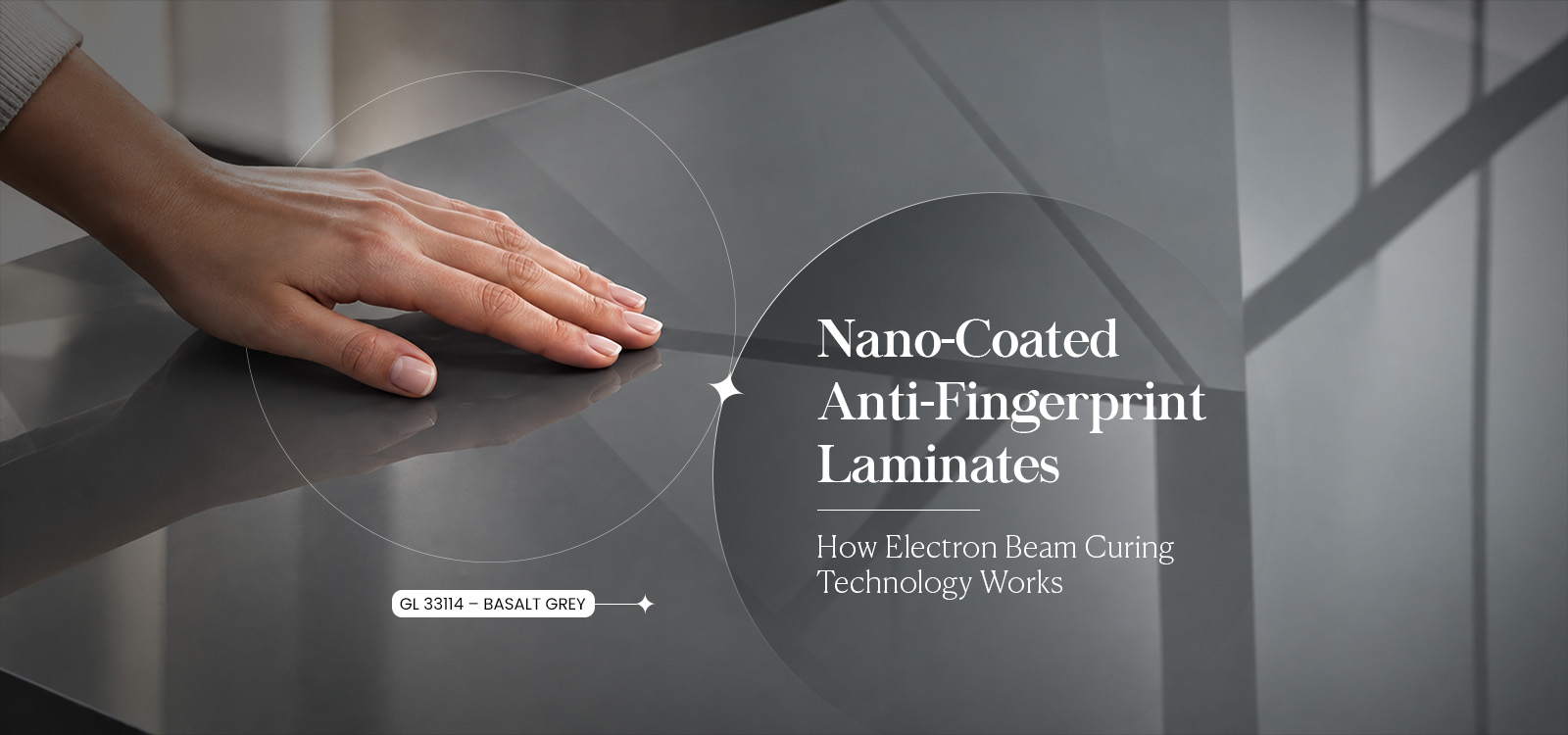
Nano-Coated Anti-Fingerprint Laminates: How Electron Beam Curing Technology Works

A nano-coated anti-fingerprint laminate is a type of laminate that uses Electron Beam Curing (EBC) technology to create a coating that is hydro- and oleophobic on a nanometer scale. Unlike UV coatings, the electron beam curing technique cross-links polymer molecules at a molecular level and forms an ultra-smooth and low-surface-energy coating that repels oils, water, and fingerprints. This results in a high-quality matte finish that remains clean almost without any effort of cleaning.
The Problem AFP Laminates Solve
Conventional matte or dark laminates show fingerprints, smudges, and oils within some hours after touch. Cabinets and wardrobe handles appear dirty almost immediately, especially in highly used places.
Recurrent cleaning may ruin the laminate’s top layer. With the invention of AFP technology, such issues no longer exist, as it allows one to make the coating in such a way that it prevents dirt from sticking to the surface of the laminate.
So, a nano-coated anti-fingerprint laminate is a very helpful product in many applications, especially where a consistently clean look is of utmost importance. This is the basic principle behind anti-fingerprint laminate: how it works, and how the surface is designed to reduce the adhesion of fingerprints, oils and moisture.
How Electron Beam Curing (EBC) Technology Works
The process of making electron beam cured laminate includes some stages:
| Step | Process | What Happens |
| 1 | Standard laminate manufacturing | Kraft paper suitable for flooring uses a mixture of Kraft paper, décor paper, and melamine resin |
| 2 | Nano-coating application | An extremely thin oleophobic and hydrophobic coating is applied to the substrate |
| 3 | Electron beam exposure | High-energy beam irradiates the nano-coating |
| 4 | Molecular cross-linking | Electron energy causes the polymer coverings to adhere molecule by molecule |
| 5 | Result | It will be ultra-dense, flat, and have a low-energy surface, which means that any oil or water will not spread on it |
The electron beam is responsible for molecular-level curing of the substrate and creation of a cross-linked structure of polymer depending on their composition.
Nano coating on the laminate surface provides oleophobic and other surface properties, preventing the penetration of oil while increasing the rate of water forming droplets instead of spreading across the surface.
The resulting oleophobic layer and hydrophobic surface help create the desired finish. This process involves molecular-level curing and creates a cross-linked polymer structure with reduced surface energy.
EBC (Electron Beam) vs UV Curing What’s the Difference?
The electron beam cured laminate process uses electrons, while the UV curing method employs UV light. An EBC’s ability to cure deeper and cross-link more strongly improves the durability of the surface. This means it is appropriate for advanced laminates that must withstand the rigours of daily use.
The difference between these technologies forms an important part of the AFP laminate technology explained, particularly because electron beam curing supports stronger cross-linking and surface energy reduction in the coating.
| Feature | Electron Beam Curing (EBC) | UV Curing (Standard) |
| Energy source | High-energy electron beam | Ultraviolet light |
| Penetration depth | Deep (through entire coating) | Surface only |
| Cross-linking quality | Superior (complete bonding) | Moderate (partial) |
| Durability of coating | 10–15 years | 5–8 years |
| Fingerprint resistance | Excellent | Good |
| Cost | Higher (advanced equipment) | Standard |
| Used by | Premium brands | Most brands |
AFP Laminate Performance in Real-World Conditions
| Test | AFP Laminate Result | Standard Matte Result |
| Fingerprint after 10 touches | Almost invisible | Easily visible |
| Oily palm print | Cleans easily with a dry cloth | Requires cleaning solution |
| Water droplet test | Beads up and rolls off | Spreads out and absorbs |
| Kitchen grease splash | No stains | Leaves marks once it dries |
| Cleaning effort | Just needs a dry wipe (5 sec) | Requires wet cloth with a cleaner (30 sec) |
This demonstrates why advanced surface technology matters in high-contact interiors: a smoother, more resistant laminate can reduce visible marks and simplify cleaning. Royale Touche’s laminate quality and performance standards provide additional context on abrasion, scratch, stain, impact, heat, and colour-fastness testing used to evaluate premium laminate performance beyond appearance alone.
Best Applications for Nano-Coated AFP Laminates
Nano-coated anti-fingerprint surfaces are especially useful in busy kitchens, wardrobes, desks, workstations, and hospitality furniture where frequent contact makes smudges more visible. Designers looking for this type of low-maintenance surface can explore Royale Touche luxury+ anti-fingerprint laminates for matte finishes developed to reduce visible fingerprints while maintaining a premium contemporary appearance.
- Kitchen cupboard doors that are prone to grease as well as finger marks.
- Wardrobe doors in the master bedroom.
- Tabletop surfaces and desks that have regular arm contact.
- Office workstations that are used by everyone in a company.
- Hotel furniture that is likely to be seen by many guests.
All these cases combine high-quality appearance with easy maintenance and protection from daily surface contamination.
AFP Laminate Colour Availability
The AFP laminates are available in different colours and finishes. Darker surfaces have drawbacks from AFP technology due to the fact that prints and smudges are distinctly visible through dark colours.
When it comes to choosing EBC laminate in India, consumers should take into account colour, texture, surface efficiency, and cleaning options, among other things. A nano-coated anti-fingerprint laminate will keep both dark and light furniture surfaces shinier.
Conclusion
AFP laminates make use of modern chemical techniques of surface curing to fight against fingerprints, smudges, and other everyday dirt. By creating a low-energy coated surface, the EBC technology allows oils and water not to spread on the laminate.
For kitchens, wardrobes, offices, and other places with frequent contact, the nano-coated anti-fingerprint laminate is a great fusion of beautiful design, reduced cleaning and efficient surface properties.
Frequently Asked Questions
1. What is nano-coated anti-fingerprint laminate?
The definition of nano-coated anti-fingerprint laminate is a type of laminate with an advanced finish that excludes grease, water, fingerprints, and any kind of dirt, leaving no trace of fingerprints, smudges, or any kind of dirt.
2. How does electron beam curing make laminates anti-fingerprint?
The principle behind electron beam curing is the use of high-power electrons inducing molecular-level bonding in the coating material, resulting in a very strong product with excellent anti-stain properties. This further demonstrates anti fingerprint laminate how it works in practical applications.
3. Is AFP laminate worth the extra cost for kitchens?
It seems to be an excellent solution for kitchens because kitchen cabinets are constantly getting greasy, and the surface will become clutter-free quite easily.
4. How long does the anti-fingerprint coating last?
The duration of the product lifetime depends on the particular mix of the coating, quality of production and how the product is used. EBC technology will lead to the creation of durable cross-linked surfaces with varying performance.
5. Can AFP laminates be cleaned with regular water?
Normal marks can be cleared with a soft cloth and water; however, always follow the manufacturer’s guide on how to use the product to wash off grease stains and tough dirt.
6. What is the difference between EBC and UV-cured laminates?
EBC is a process done with the help of electron beams, while UV curing means curing with UV light. EBC makes the curing stronger and gives better performance to the anti-fingerprint surface on the final product.