

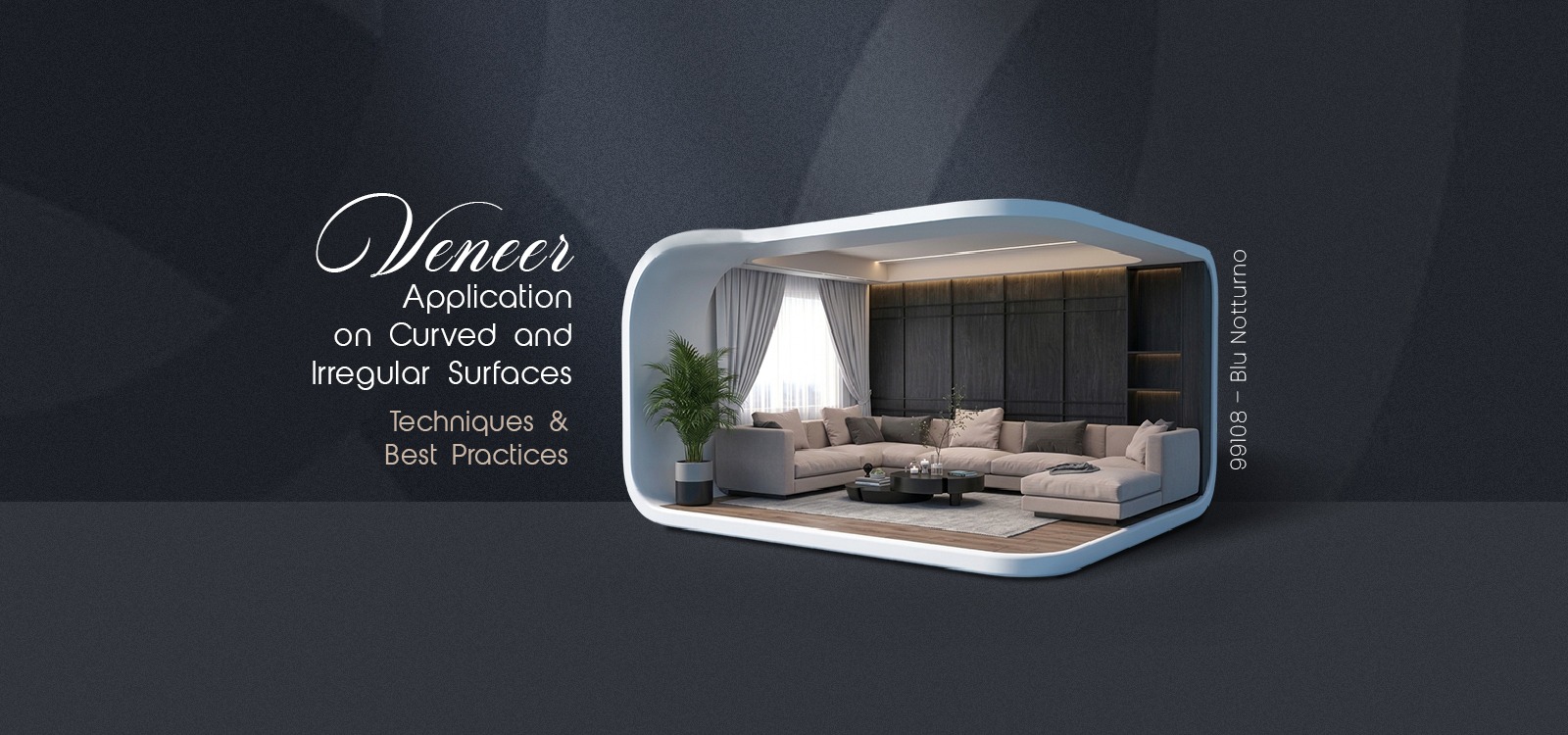
Veneer Application on Curved and Irregular Surfaces: Techniques & Best Practices

Cleaning furniture with curves and round surfaces can be hard, but they can make any room look better. When installing veneer on curved surfaces, it is crucial to employ the appropriate tools, adhere to the correct procedures, and exercise caution to prevent the formation of fractures or uneven bonding. Structured methods can improve the look and feel of even the hardest designs.
Why Is Veneering Curved Surfaces Challenging?
A few technical challenges arise when working with veneer on curved surfaces:
- Grain direction: Incorrect placement increases the risk of veneer cracking during bending.
- Adhesion control: A non-flat base must have glue applied uniformly.
- Seam finishing: Bends make it more difficult to conceal joints.
It is imperative to possess the knowledge of how to apply veneer to curved furniture prior to attempting to proceed. In this situation, it is preferable to be accurate than to be expeditious.
Types of Veneer Sheets That Work on Curved Surfaces
Choosing the right material is very important when veneering curved surfaces.
| Veneer Type | Flexibility | Best For |
|---|---|---|
| Paper-backed veneer | Very high | Tight curves, columns |
| 0.5mm raw veneer | High | Gentle curves |
| Fleece-backed veneer | High | Irregular shapes |
| Standard 0.6mm veneer | Moderate | Slight curves |
Paper-backed veneer is the most suitable option for tight applications like round columns due to its flexibility. Before choosing, it helps to understand the veneer sheet thickness options available; thinner sheets like 0.3mm and 0.4mm are specifically recommended for curved and irregular surfaces without cracking.
Step-by-Step: How to Apply Veneer on Curved Furniture
The following rules should be followed when learning how to apply veneer on curved furniture:
- Select flexible veneer
For curves, paper-backed sheets work well. - Cut slightly oversized
Leave some wiggle room and make sure the grain is parallel to the curvature. - Apply adhesive
Use contact cement on both surfaces evenly - Position and press
Starting at the center, radiate outward. Apply the correct amount of pressure: Clamps or a vacuum press can make sure the connection is even. - Allow curing time
Leave it for 24 hours for strong adhesion - Trim and finish
Smooth edges for a clean look
Using this approach guarantees consistent outcomes when working with veneer on curved surfaces.
Tools and Adhesives You’ll Need
It is possible to enhance the quality of veneer on curved surfaces by employing the appropriate tools:
- Clamps or a vacuum press to provide consistent pressure
- For a secure binding, use contact cement
- Rollers for deflating squirms
- Implementing precise cutting techniques
- Finishing sandpaper
In certain instances, steam bending can be beneficial in enhancing the flexibility of natural veneers. A stable foundation is provided by veneer application on MDF, which is a preference among many professionals.
Common Mistakes When Veneering Curves
When employing veneer on curved surfaces, take care to avoid the following common errors:
- Wrong grain direction: Leads to cracks during bending
- Thick veneer use: Difficult to bend on tight curves
- Uneven adhesive: Causes bubbles or weak bonding
- Insufficient pressure: Results in lifting over time
By adhering to the appropriate veneer bending technique, both durability and aesthetic appeal can be preserved. Utilising premium materials, including those from Royale Touche Laminates, can also enhance consistency.
The application of veneer to curved surfaces necessitates meticulous attention to detail; however, the outcome is well worth the effort. Even intricate shapes can be completed efficiently with the appropriate veneer type, adhesive, and controlled pressure.
The correct technique for treating curves enables the creation of more inventive design possibilities, as opposed to avoiding them. Royale Touche are dependable alternatives that facilitate the attainment of a clean and durable finish thereby enabling the development of interiors that are
meticulously designed and comprehensive.
Frequently Asked Questions
1. Can natural veneer be applied on curved surfaces?
One can go for pliable veneer sheets and apply the same on curved surfaces.
2. Which veneer type is most flexible?
Paper-backed veneer is one of the most flexible options for use in tight curves and intricate surface applications.
3. What adhesive works best?
Contact cement works best as an adhesive as it allows for even, long lasting bonding adhering to curved surfaces.
4. How do you prevent cracking?
Go for thinner veneer sheets that are flexible. Make sure to align the grain properly.
5. Can curved surfaces be veneered at home
For implementing smaller projects, one can make use of basic tools, have proper preparation in place for best results.