

Post-Forming Laminates: Curved Edges & Seamless Furniture Design

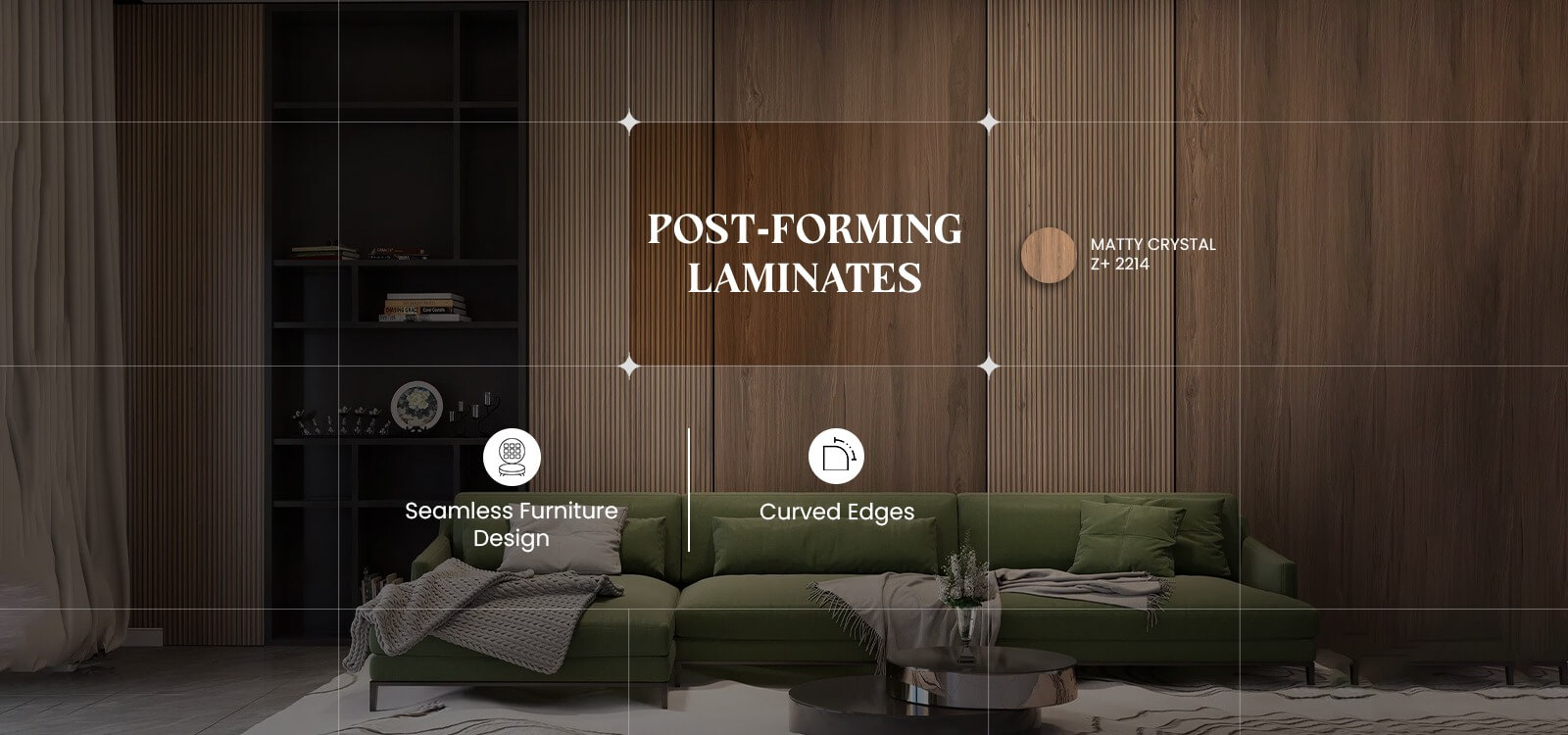
Modern furniture design is increasingly turning to curves, smooth surfaces and precise detailing. A post-forming laminate is designed to bend around curved edges using heat and pressure to create a continuous surface without seams or edge banding. These laminates are ideal for counters, tables, cabinets, and reception desks that are normally available in thinner thicknesses of 0.6 mm to 0.8 mm. The Royale Touche post forming range offers hundreds of styles that blends appearance with utility delivering improved protection from moisture and better lasting results.
What Is Post-Forming Laminate and How Does It Work?
A post-forming laminate is more flexible in terms of shaping. It can be thermoformed to the shape of an object with rounded edges.
During installation, the laminate is heated to about 160-170°C, then carefully wrapped around the edge of the pre-formed substrate. Radius bending is a technique to create a seamless wrap, without seams and edge bands. This technique improves the aesthetics and functionality of the profile by rounding it and smoothing it out.
A post-forming laminate, in contrast to flat-surface laminates, may be bent and shaped without sacrificing surface uniformity.
Royale Touche Post-Forming Laminate Range
The Royale Touche post forming range comes in a range of finishes for commercial and household interiors.
| Collection | Designs Available | Thickness | Minimum Bend Radius |
|---|---|---|---|
| Woodgrain PF | 80+ patterns | 0.6 mm / 0.8 mm | 6 mm |
| Solid Colour PF | 60+ shades | 0.6 mm / 0.8 mm | 6 mm |
| Stone & Marble PF | 30+ patterns | 0.8 mm | 8 mm |
| Metallic PF | 15+ finishes | 0.8 mm | 10 mm |
| Textured PF | 40+ textures | 0.8 mm | 8 mm |
This large variety of forms allows the designer to produce visually interesting curved surfaces without compromising elegance.
Post-Forming vs Flat-Pressed (Standard) Laminate
Making the right decision for a project requires knowledge of the uses of both –post forming laminate vs flat pressing laminate.
| Feature | Post-Forming Laminate | Standard Flat Laminate |
|---|---|---|
| Flexibility | Bends around curves | Suitable for flat surfaces |
| Thickness | 0.6–0.8 mm | 0.8–1.5 mm |
| Edge Treatment | Seamless wrap | Requires edge banding |
| Moisture Protection | Sealed edges | Edge band may loosen over time |
| Best Applications | Countertops, tables, rounded cabinets | Doors, panels, walls |
| Appearance | Continuous surface | Visible edge joints |
A post-forming laminate gives cleaner, more integrated surfaces for curved furniture exploring the complete types of laminates to understand where post-forming fits within the broader laminate range.
Where Post-Forming Laminates Work Best
Post-forming laminate solutions are appropriate for a wide variety of applications due to their highly adaptable nature.
Kitchen Countertops
A post forming laminate for countertop installations to provide smooth bullnose and waterfall edges without visible seams.
Dining and Conference Tables
The softened corners make it more comfortable and more safe at home and business.
Office Desks
Curved front borders on workspaces not only look nice, they work better.
Cabinet Doors
Curved edge laminate for furniture avoids unattractive edge bands.
Reception Counters
Polished, seamless surfaces communicate sophistication and competence.
Bathroom Vanities
Sealed edges keep water out and ensure durability.
How Post-Forming Is Done?
The following is a typical rule of thumb to follow when installing:
1. Trim the laminate to the required size allowing enough to wrap it around.
2. Adhesion of the laminate to the substrate.
3. Begin by connecting the level surface.
4: Warm to soften overhanging laminate.
5. Bending around the curve that has been made.
6. Keep pressure on until the object is cool and locked in position.
7. Removing excess material to leave a smooth surface.
Using a standard bendable laminate sheet, this procedure produces a perfectly smooth, spherical surface with no apparent borders.
Why Designers Recommend Post-Forming for Kitchen Countertops
Post-forming laminate is the material of choice for designers due to its practicality and aesthetic appeal. There is less likelihood of peeling and more protection from moisture damage thanks to sealed edges and the absence of edge bands. Houses with rounded profiles are safer for families with children and have a more modern, softer look.
Round edge laminate offers premium aesthetics at a lower cost and also explores compact laminates for countertops and tabletops as a complementary option for high-use surfaces.
Frequently Asked Questions
1. What is a post-forming laminated sheet?
The post forming laminate sheet India is a flexible type of laminate which can be bent around curved edges with the use of heat and pressure.
2. How is post-forming laminate different from regular laminate?
A post-forming laminate can encircle curves and provide perfect edges, however most laminates are designed to rest flat.
3. Can all laminates be post-formed?
No, only laminates intended for post-forming can be bent without shattering.
4. What is the minimum bend radius for post-forming laminates?
Some collections can achieve a minimal bend radius of 6 mm. This may depend on the design and thickness.
5. Is post-forming laminate more expensive than standard laminate?
The price difference is usually slight for the better polish and usefulness although it does vary by design and specification.
6. Where can I buy Royale Touche post-forming laminates in India?
The Royale Touche post forming range is available with Royale Touche licensed dealers and distributors in India.